

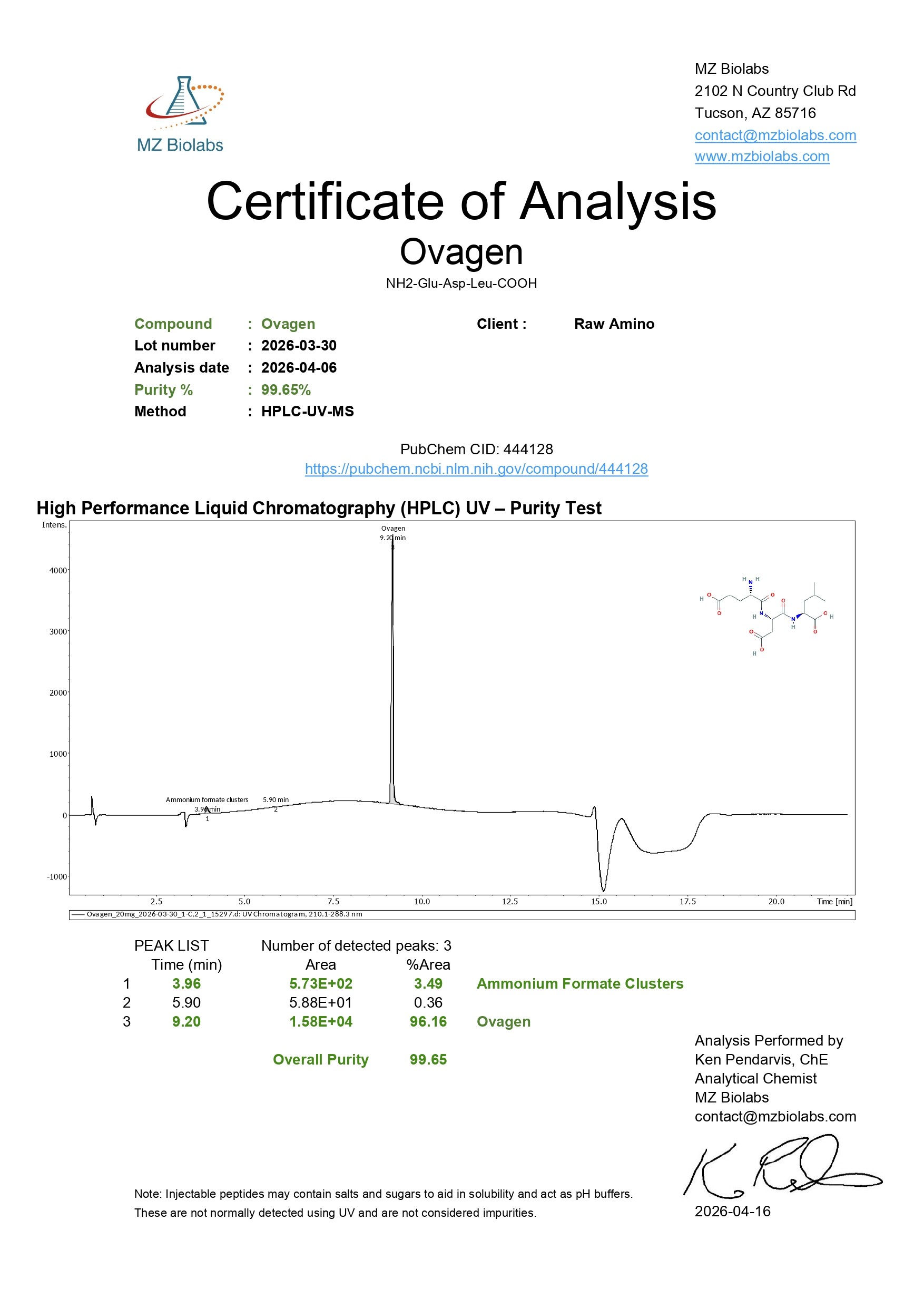
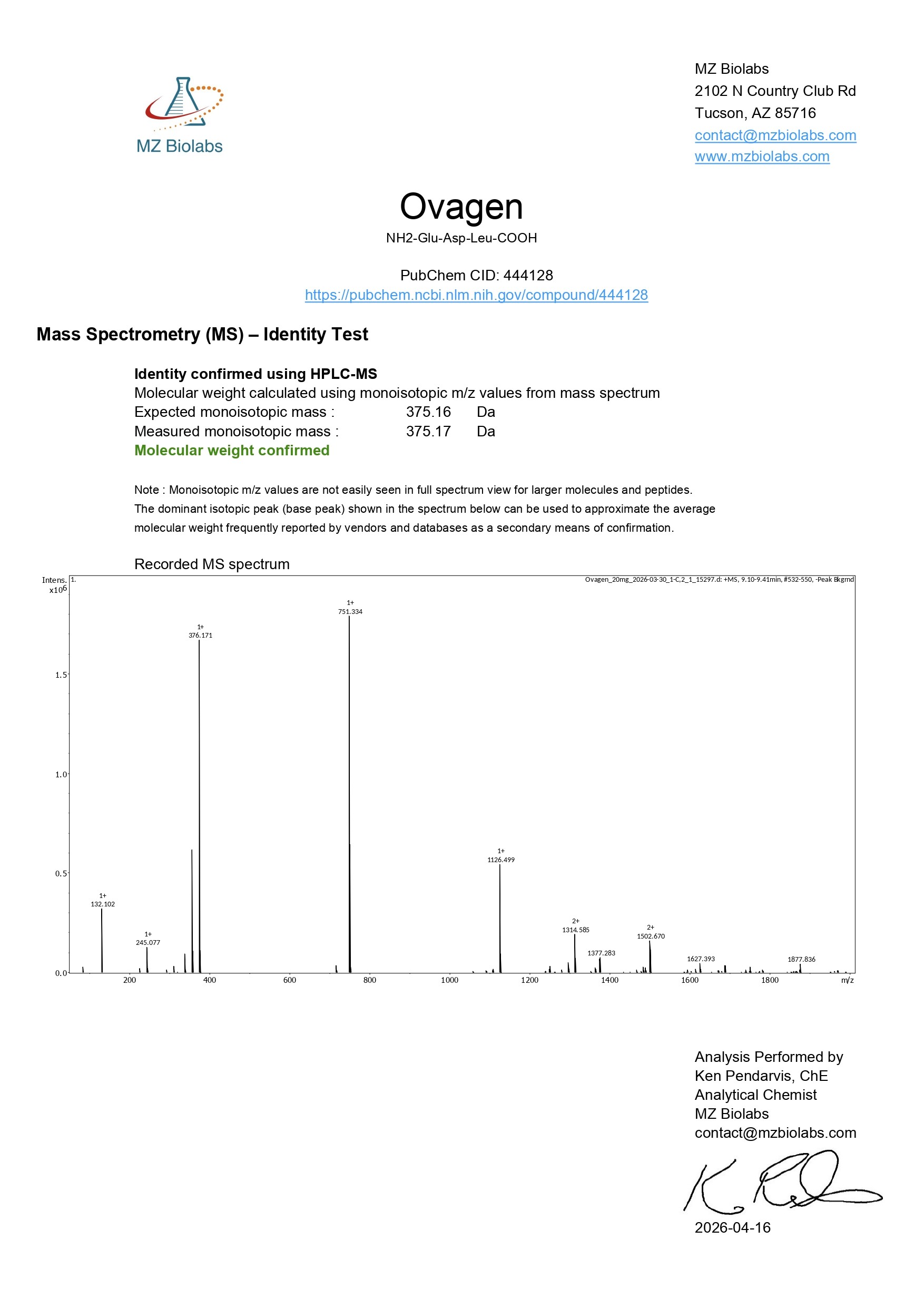
Ovagen – 20MG
$63.00
Discount per Quantity
| Quantity | 5 - 8 | 9 + |
|---|---|---|
| Discount | 5% | 10% |
| Price | $59.85 | $56.70 |
Scientific Overview of Ovagen
Ovagen is a short bioregulatory peptide associated with research into cellular regulation within hepatic and epithelial tissues. It is classified within the group of Khavinson-type peptides, which are studied for their potential involvement in maintaining genomic stability and supporting cellular resilience under stress. Preliminary findings suggest that peptides of this class may participate in modulating chromatin structure and interacting with gene-regulatory elements, though these mechanisms remain the focus of ongoing laboratory research.
Early investigations propose that Ovagen may influence experimental systems characterized by oxidative stress or structural damage, particularly models involving liver cells. The peptide is often studied for its possible contribution to normalizing functional markers, stabilizing cellular activity during toxic load studies, and supporting epithelial recovery in controlled in-vitro environments. While the exact molecular pathways are still being clarified, Ovagen appears to belong to a category of peptides that may help maintain cellular organization across select tissue types.
Alternative Names: Ovagen peptide, cytoprotective bioregulatory peptide
Studies and Research Data
Genomic Modulation and Chromatin Dynamics
Research on related bioregulator peptides has suggested that short peptides may interact with chromatin in aging or stressed cells. These interactions may contribute to chromatin decondensation and the possible reactivation of genes that appear silenced during cellular aging processes. In some laboratory models, peptide exposure has been associated with increased transcriptional activity in regions connected to cellular repair functions. Although the precise interaction of Ovagen with these pathways remains under investigation, it is often grouped with peptides that appear to influence epigenetic organization.
Hepatic Cell Models and Cytoprotection
One key area of interest for Ovagen has been hepatic tissue models exposed to chemical or metabolic stressors. Studies describe that related peptides may help normalize experimental indicators of hepatocyte function and enhance cellular tolerance to adverse conditions. Some hepatotoxicity models have reported apparent reductions in structural disruption and more stable biochemical readings following peptide exposure. These findings suggest potential pathways involving oxidative stress modulation, but definitive mechanisms remain inconclusive.
Epithelial Recovery in Experimental Damage Models
Another research direction examines whether Ovagen may support structural integrity in epithelial cells subjected to external stressors. Early laboratory observations propose that exposure may correlate with improved restoration of epithelial barrier morphology. Model data also note possible changes in cell-to-cell communication and membrane organization, although these outcomes vary by model type and require further controlled validation.
Systemic Stress and Organ Function Models
Broader investigations have included Ovagen in systemic stress frameworks, where multi-organ models are used to evaluate resilience markers. Some reports describe potential normalization of functional parameters across organs sensitive to toxicity or inflammation. The peptide’s positioning within these studies indicates a continuing interest in its possible cross-tissue regulatory roles, though evidence remains preliminary and exploratory.
Conclusion
Ovagen is being researched for its potential involvement in genomic regulation, hepatic cell stability, epithelial structure support, and general cytoprotective pathways. Current findings remain based on controlled experimental models, and while early observations suggest a range of possible biological interactions, the mechanisms and reliability of these actions are not yet fully established. Continued laboratory research is required to clarify its scientific relevance.
References
- Kuznik BI., Baranchugova LM., Obydenko VI., et al. Advances in Gerontology. 2011.
- Khavinson VK., Linkova NS., Mironova ES., et al. Peptide Regulation of Gene Expression: A Systematic Review. Molecules. 2021.
- Fedoreyeva LI., Kireev II., Khavinson V., Vanyushin BF. Biochemistry (Moscow). 2011.
- Dzhokhadze TA., Buadze TZh., Gaiozishvili MN., et al. Georgian Medical News. 2012.
Disclaimer:
The products mentioned are intended solely for laboratory research and in-vitro experimentation. They are not approved for human or animal use of any kind. All details provided are for educational purposes only. By purchasing from this site, you agree to comply with our Terms and Conditions.
Only logged in customers may leave a review.

Reviews
There are no reviews yet.